
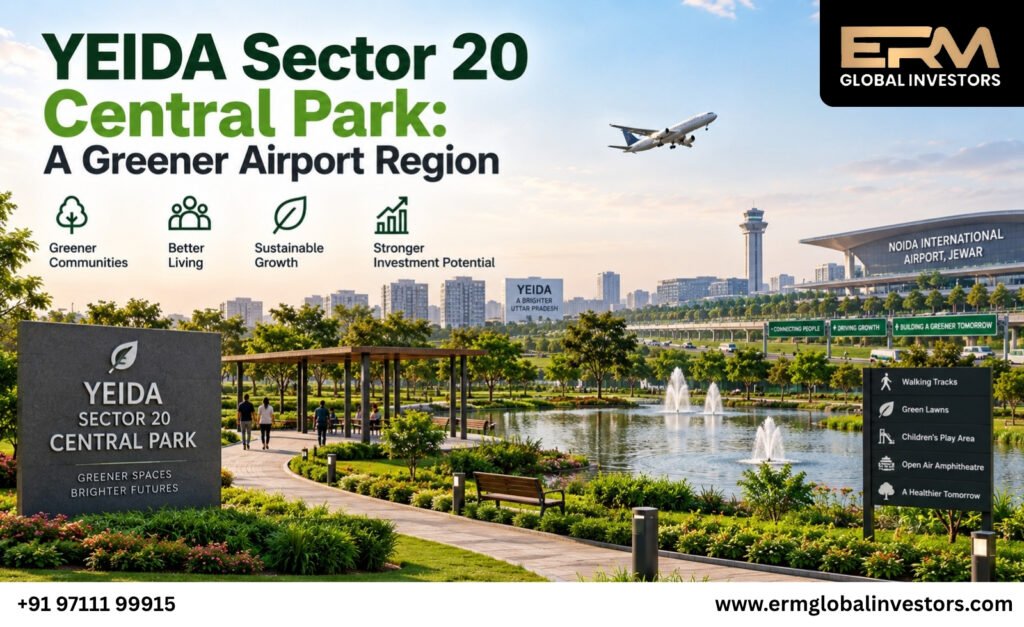
The proposed 14-acre central park in YEIDA Sector 20 represents more than a recreational project. It signals a shift towards balanced urban development as residential, commercial and industrial plots activity expands around Noida International Airport.
Roads, housing and employment hubs may drive economic growth, but liveable cities also require accessible public spaces. If designed and maintained effectively, the YEIDA Sector 20 central park could become an important social and environmental asset for the growing Yamuna Expressway region.
What Is Planned for the YEIDA Sector 20 Central Park?
The Yamuna Expressway Industrial Development Authority plans to develop a central park covering approximately 14 acres in Sector 20. Publicly reported features include:
- Open lawns and landscaped green areas
- Walking and exercise paths
- Seasonal flower beds
- Grassy mounds
- Fountains and water features
- Swings and family recreation facilities
- Spaces for relaxation and community activity
These features suggest that the park is being planned as an everyday public amenity rather than only as a decorative landscape.
Sector 20 is one of the important residential sectors within the YEIDA region. Approximately 20,000 residential plots have reportedly been allotted across Sectors 18 and 20, increasing the need for parks, pedestrian infrastructure and community facilities.
Expected Timeline and Current Project Status
The central park proposal has developed over several stages. Reports published in 2024 indicated that YEIDA intended to create 37 parks near the airport region, with the 14-acre park in Sector 20 planned as the largest of them.
As of September 2026, the design and proposed facilities have reportedly been finalized by YEIDA’s horticulture department. However, a confirmed construction-start date, project cost and completion deadline have not yet been publicly detailed.
This distinction is important for residents and property buyers. A finalized landscape plan shows progress, but the following milestones should still be monitored:
- Tender publication and agency appointment
- Site development and landscaping work
- Irrigation and drainage installation
- Lighting, security and public facilities
- Formal completion and opening date
- Long-term maintenance arrangements
Until an official tender or project notice is released, completion estimates should be treated as provisional.
How Could the Park Affect Traffic and Local Mobility?
A large urban park can improve neighbourhood walkability, but it can also attract additional traffic during mornings, evenings, weekends and public holidays.
YEIDA will need to integrate the park with Sector 20’s wider road network. Safe crossings, continuous footpaths, cycle access, shaded walkways and controlled parking would help residents reach the park without relying entirely on private vehicles.
Important mobility measures may include:
- Clearly marked pedestrian crossings
- Separate entry and exit points
- Accessible paths for senior citizens and wheelchair users
- Designated parking and drop-off areas
- Cycle stands near park entrances
- Traffic-calming measures near residential pockets
- Last-mile links to future public transport
A park should not be treated as an isolated plot of greenery. Its success will depend on how safely and conveniently it connects with homes, local markets and transport routes.
Environmental Benefits for the Airport-Growth Corridor
Airport-led urban development can increase construction activity, paved surfaces, vehicle movement and pressure on local resources. A properly designed urban park can help moderate some of these effects.
Trees and planted areas can provide shade, support rainwater absorption and reduce local heat. Native plants generally require less intensive maintenance and may be better suited to local environmental conditions than purely ornamental landscaping.
The park could deliver stronger environmental value if its design includes:
- Native and climate-appropriate tree species
- Rainwater-harvesting systems
- Permeable walking surfaces
- Bioswales for stormwater management
- Energy-efficient lighting
- Composting of horticultural waste
- Separate waste-collection points
- Water-efficient irrigation
- Protection from excessive commercial construction
The 14-acre park alone cannot offset every environmental impact associated with airport-region expansion. However, it could become a valuable part of a wider network of parks, green belts and ecological corridors.
Economic and Property-Market Impact
Well-maintained parks can make developing neighbourhoods more attractive to residents, businesses and service providers. In Sector 20, the project may strengthen demand for daily-use retail, fitness services, cafés and other neighbourhood facilities.
Properties located near usable green spaces may also attract greater buyer interest. However, the announcement of a park does not guarantee property appreciation or investment returns.
Prices will continue to depend on several factors:
- Infrastructure delivery
- Road and public-transport connectivity
- Plot location and legal status
- Airport operations and passenger growth
- Employment creation
- Commercial development
- Availability of schools and healthcare
- Quality of civic maintenance
Noida International Airport’s master plan provides for an initial capacity of 12 million passengers annually, with phased expansion planned according to future demand. This scale helps explain why YEIDA is simultaneously planning residential, industrial and social infrastructure around the airport corridor.
What Residents and Plot Owners Will Expect
For existing plot owners, the central park may represent visible progress towards making Sector 20 a functional residential neighbourhood. Future residents are likely to value open spaces where children can play, families can meet and adults can walk or exercise safely.
Their expectations, however, will extend beyond landscaping. Long-term usefulness will depend on practical details such as:
- Security guards and CCTV coverage
- Clean public toilets
- Drinking-water facilities
- Adequate seating and shaded areas
- Reliable lighting
- Regular horticultural maintenance
- Inclusive access
- Clear opening hours
- Noise and vendor management
Resident participation can improve outcomes. YEIDA could consider structured feedback from plot owners, resident associations and accessibility experts before final execution.
Comparison and Future Outlook for YEIDA Development
Noida already has different models of public green infrastructure, including themed parks and biodiversity-focused spaces. These projects show that an attractive launch is only the beginning; maintenance, security and accessible facilities determine whether a park remains useful over time.
Sector 20’s proposal differs from a destination-style theme park. Its main value is likely to come from supporting everyday life in the surrounding residential pockets. That makes consistent upkeep more important than expensive attractions.
The wider YEIDA region is being developed as an integrated urban and industrial corridor. The authority’s published plans include Noida International Airport, Film City, a Medical Devices Park, a logistics park and specialised industrial clusters. YEIDA’s official website identifies planned and sustainable residential, commercial, institutional and industrial development as part of its wider mandate.
Looking ahead, the Sector 20 central park could demonstrate whether airport-led development can also deliver inclusive public infrastructure. Its real success should be measured through tree survival, accessibility, safety, maintenance and regular community use—not merely by its acreage.
Final Thoughts
The proposed YEIDA Sector 20 central park could improve liveability across one of the airport region’s most closely watched residential areas. Its green spaces, walking routes and recreation facilities may support healthier community life while adding environmental balance to rapid urban expansion.
Residents and investors should monitor official YEIDA announcements for tender, construction and completion updates. For verified guidance on YEIDA plots, documentation and the developing Yamuna Expressway corridor, contact ERM Global Investors for end-to-end assistance. Final allotments and approvals remain solely under the relevant authority.