
Introduction
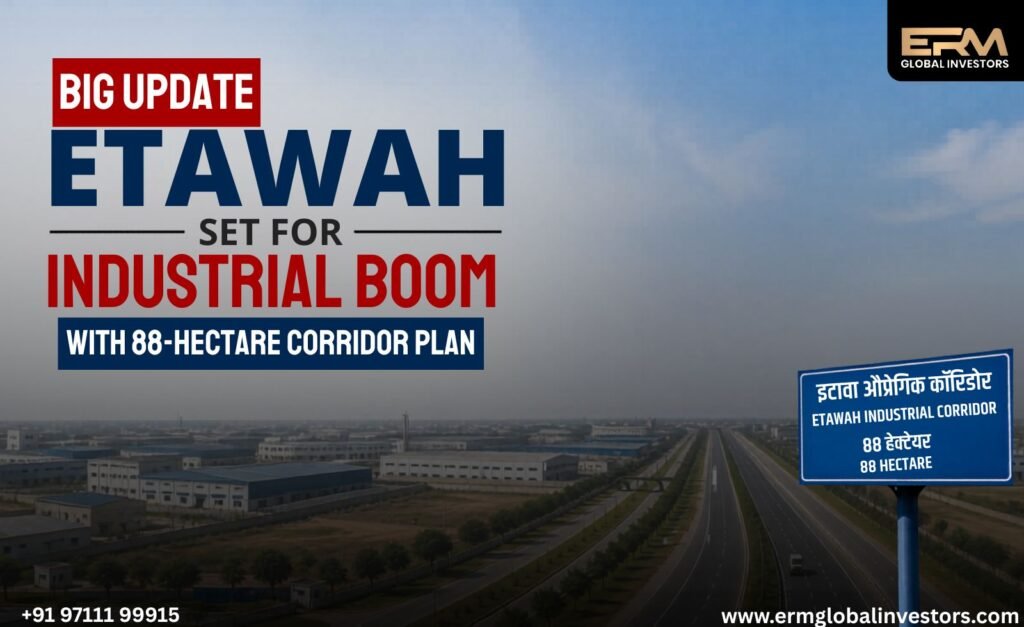
A major infrastructure-led transformation is unfolding in Uttar Pradesh, and Etawah is at the center of it. The announcement of an 88-hectare industrial corridor along the Bundelkhand Expressway is not just another development update—it signals a structural shift in how this region will attract industries, logistics players, and long-term capital.
For investors tracking emerging micro-markets beyond saturated cities like Meerut, Unnao, Hardoi, and Sambhal, this development raises an important question: Is Etawah the next high-growth industrial real estate destination?
Key Takeaways
- 88 hectares of industrial land planned across Kakraai village (52 hectares) and Bharthana tehsil (36 hectares)
- Strategic placement along Bundelkhand Expressway enhances logistics efficiency
- Developed by UPEIDA, ensuring structured planning and phased development
- Potential to drive industrial demand, job creation, and land value appreciation
- Early-stage opportunity with both upside potential and execution risks
Why Etawah Now? Unpacking the Strategic Location and Connectivity
Etawah’s importance comes from its connectivity backbone, not just the project size.
The Bundelkhand Expressway connects key districts of Uttar Pradesh and integrates with larger highway networks, reducing travel time and logistics costs significantly. For industries, this translates into faster supply chains and lower operational expenses.
Compared to established zones near Meerut or western UP, Etawah offers:
- Lower entry cost for land acquisition
- Proximity to developing industrial belts
- Direct expressway access for freight movement
For investors in Unnao, Hardoi, or Sambhal looking to diversify beyond residential plots, this corridor introduces a new industrial-led growth story.
Why it matters: Industrial growth often precedes residential and commercial demand. Early entry into such corridors has historically delivered better ROI than late-stage urban investments.
The 88-Hectare Industrial Corridor: A Deep Dive into UPEIDA’s Vision
The corridor is being developed by the Uttar Pradesh Expressways Industrial Development Authority (UPEIDA)—a key indicator of planned execution rather than fragmented development.
Land Distribution
- Kakraai village: 52 hectares
- Bharthana tehsil: 36 hectares
Planned Development Features
- Boundary wall construction to secure the zone
- Phased industrial plot allocation
- Infrastructure provisioning (roads, utilities, logistics access)
There are also indications that the project could align with broader frameworks like integrated manufacturing and logistics clusters, which are critical for attracting mid-to-large scale industries.
Why it matters: Government-backed industrial corridors reduce the risk of unplanned growth, a common issue seen in smaller towns. Structured planning improves long-term sustainability and investor confidence.
Investment Potential: What This Means for Property Investors and End-Users
The Etawah Industrial Corridor Investment opportunity is primarily driven by three factors:
Industrial Demand Creation
As industries set up operations, demand rises for:
- Worker housing
- Rental accommodations
- Warehousing and ancillary services
Land Appreciation Cycle
Historically, areas near expressways have seen gradual but steady appreciation, especially after:
- Infrastructure completion
- First wave of industrial occupancy
Spillover Impact
Cities like Meerut have already matured in terms of pricing. Investors are now exploring next-tier growth zones, and Etawah fits that profile.
Example Scenario: An investor entering at the pre-development stage in Etawah could benefit from price appreciation once:
- Plots are allocated
- Industries begin operations
- Local demand ecosystem develops
Beyond the Hype: Risks and Long-Term Outlook
No investment is without risk, and ignoring this can lead to poor decisions.
Key Risks
- Execution Delays: Government projects can face timeline shifts
- Demand Lag: Industrial occupancy may take time to build
- Liquidity Challenges: Selling early-stage land can be difficult
Mitigation Strategy
- Focus on long-term holding (5–8 years)
- Invest in clear-title, authority-approved plots only
- Avoid speculative buying without infrastructure visibility
Who Should Invest?
- Long-term investors with moderate risk appetite
- Buyers looking to diversify beyond residential markets
- Investors already active in UP markets like Unnao or Hardoi
Who Should Avoid?
- Short-term traders expecting quick flips
- Buyers without understanding of industrial real estate cycles
Final Thoughts
The Etawah industrial corridor is not just a policy announcement—it represents a calculated step toward decentralizing industrial growth in Uttar Pradesh. For investors who understand infrastructure-led expansion, this is a strategic early-entry opportunity, not a quick-profit play.
Markets like Meerut have already seen their growth cycle mature, and attention is gradually shifting toward emerging belts. Etawah, supported by expressway connectivity and UPEIDA’s planning, has the potential to evolve into a notable industrial and logistics hub over the next decade.
For investors seeking structured guidance, data-backed insights, and on-ground evaluation of such opportunities, ERM Global Investors provides professional advisory support to help navigate emerging real estate markets with clarity and confidence.