
Introduction
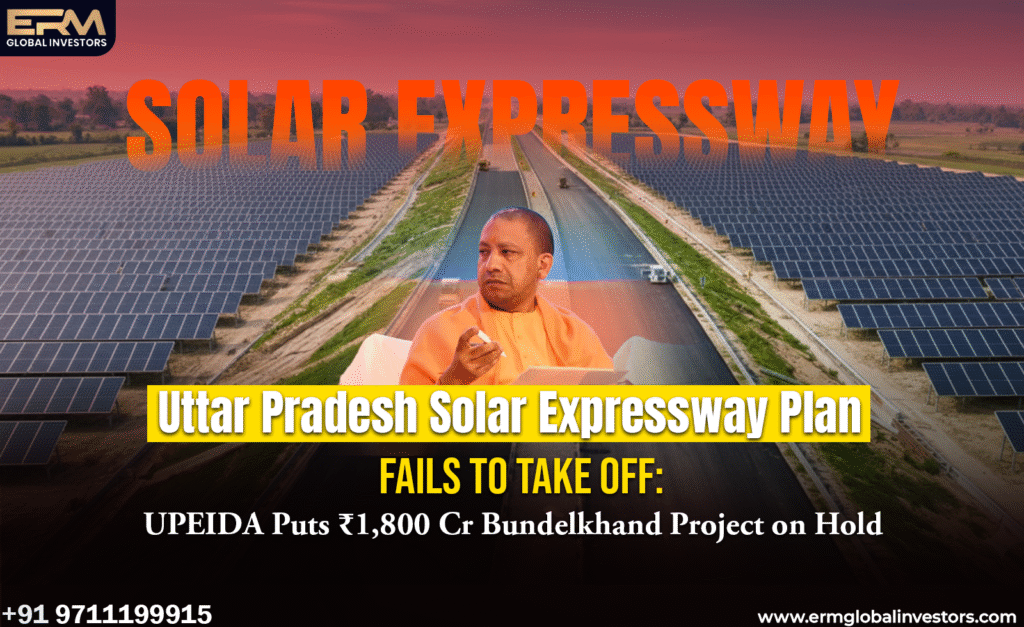
The Uttar Pradesh government had planned a very ambitious solar power project along the Bundelkhand Expressway. This project was designed to turn the expressway into India’s first true “solar expressway,” where unused land on both sides of the road would be used to generate clean and affordable electricity. The idea was praised for being modern, eco-friendly, and capable of supporting thousands of homes in the Bundelkhand region.
However, despite strong planning and a detailed project report, the ₹1,800 crore solar expressway project has now been put on hold. UPEIDA, the agency responsible for major expressway development in Uttar Pradesh, attempted to find investors twice but did not receive a single bid. With no companies showing interest, the government had no choice but to pause the project.
What the Solar Expressway Project Aimed to Achieve
A New Approach to Clean Energy
The Bundelkhand Expressway covers around 296 kilometers, connecting several districts across the region. UPEIDA planned to install solar panels across a 15 to 20-metre-wide stretch of unused land along both sides of the highway. This space is normally left vacant for safety and expansion, but the plan was to convert it into a large solar power zone.
Powering Over One Lakh Homes
According to the approved plan, the project was expected to generate between 450 and 500 megawatts of power. This amount of electricity could support nearly one lakh homes in districts such as Chitrakoot, Banda, Mahoba, Hamirpur, Jalaun, Auraiya, and Etawah. It would have brought clean and stable electricity to many parts of Bundelkhand, a region that often faces power shortages.
A Detailed Project Report Already Completed
UPEIDA had already prepared a complete project report and suggested a tariff of ₹4.00 to ₹4.50 per unit. This made solar power affordable for both the government grid and the people. By combining road infrastructure with solar production, Uttar Pradesh hoped to create a new model of expressway development that could inspire other states.
Why the Project Failed to Attract Investors
No Assured Power Purchase
Although the concept was strong and the land was ready, private companies were not willing to invest without a clear guarantee that the government would buy all the electricity generated. Solar projects require a very high initial investment, and without a purchase guarantee, the risk becomes too high for investors.
UPEIDA did not agree to commit to buying all the power, and because of this, companies felt the financial plan was not secure.
Two Tender Attempts, No Participants
UPEIDA floated the tender twice, hoping companies would show interest in such a large and unique project. Both times, there was not a single bidder. Without investor confidence, the project could not move forward, forcing the authority to place it on hold.
How This Affects Uttar Pradesh’s Growth Plans
A Missed Chance for Innovation
This project could have made Uttar Pradesh a leader in renewable energy, combined with expressway development. It would have brought clean energy to large rural areas and allowed the state to save land, reduce pollution, and create new jobs.
The Door Is Still Open
Experts believe this idea may return in the future if the government offers stronger financial support or decides to guarantee the purchase of electricity. Uttar Pradesh is already working on many solar parks and green energy initiatives, so a revised version of this expressway project may be possible someday.
Conclusion
The fact that the Bundelkhand Solar Expressway project has been at a standstill for quite some time demonstrates that even powerful ideas require backing by finance and the confidence of investors in order to eventually be successful. This idea, with more favourable policies and sufficient support, could very well be the next big thing in the development of Uttar Pradesh.
At ERM Global Investors, we monitor the big expressway projects, renewable energy projects, and real estate projects all over Uttar Pradesh. If you are a buyer or an investor, whether you are seeking residential land, agricultural land, or investment-ready plots in the vicinity of major expressways, we equip you with the right information to make the most profitable decisions.